
Case study, UAE hospitality
The 45-minute check-in problem in Dubai hotels
Dubai welcomed more than 17 million international overnight visitors in 2023, and that flow does not spread evenly through the day. Between 2 PM and 6 PM, when long-haul flights from Europe and Asia land in waves, front desks at four- and five-star hotels along Sheikh Zayed Road and the Marina routinely stack up ten to twenty parties deep. Guests arrive tired, staff work at a sprint, and the first impression a hotel spent millions to design gets flattened into a wait in line. Self-service kiosks are the intervention several operators have started leaning on to fix it.
Before and after: what the lobby actually feels like

Peak-hour queues of 15 to 25 minutes, two agents juggling arrivals, departures, and phone lines, and guests visibly frustrated before they see their room.
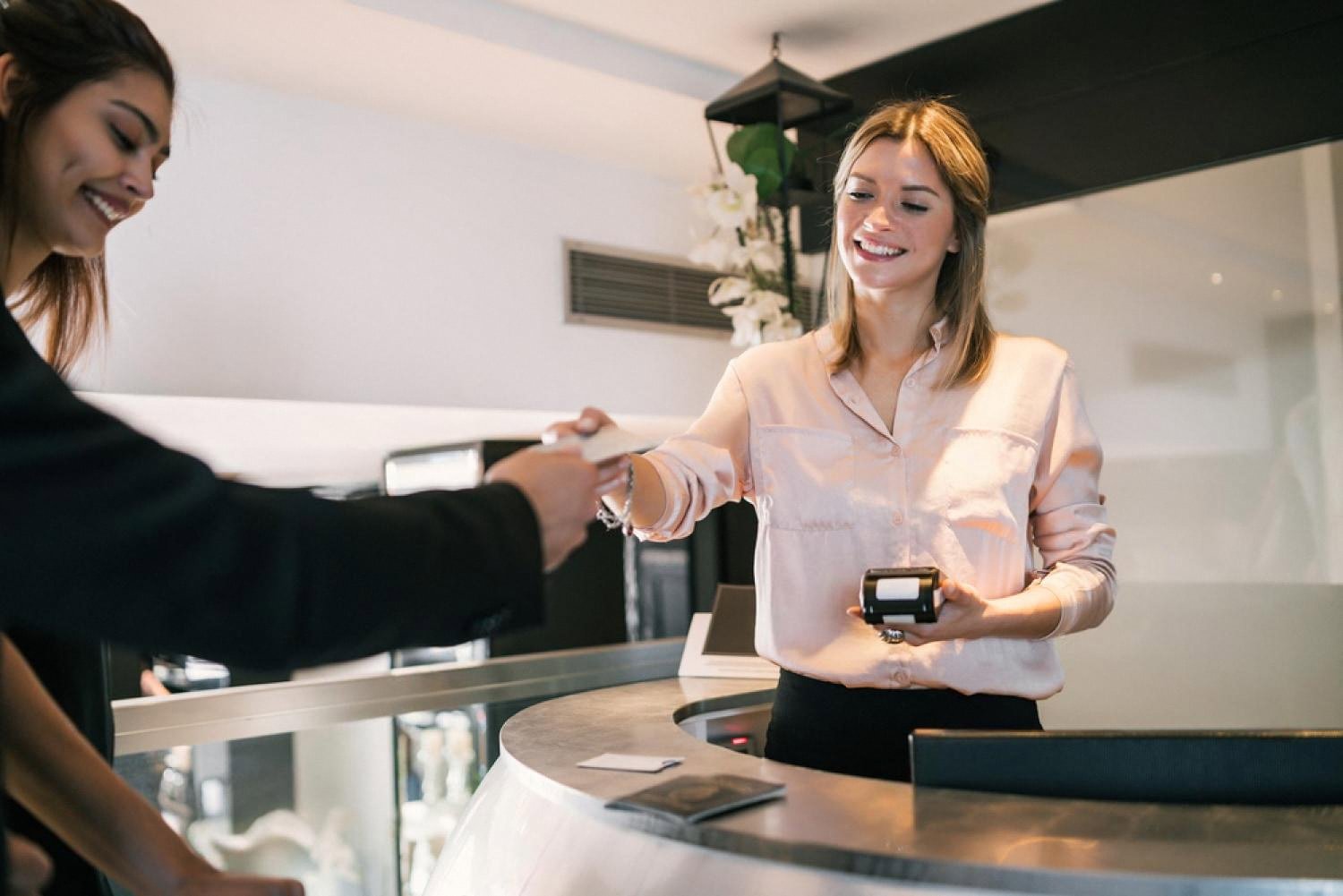
Four kiosks handle routine arrivals in under two minutes each. The desk keeps two agents free for VIPs, complex bookings, and genuine hospitality.
What we tried first
The fixes that only partly worked
Before turning to self-service, most Dubai properties try the obvious levers. They add staff, they push pre-arrival emails, they promote mobile check-in through the loyalty app. Each helps a little, none of them dissolves the peak-hour bottleneck. Here is the honest list of what was tested and where each option ran out of road.
- More front-desk agents. Payroll rises, but during quiet hours agents sit idle. The average lobby is loaded for maybe four hours a day.
- Pre-arrival online check-in. Useful, but UAE hotels are legally required to sight the guest’s passport or Emirates ID for the tourism registration system, so the guest still has to stop at the desk.
- Splitting queues by loyalty tier. Improves the experience for elites, worsens it for everyone else, and generates a fresh set of complaints on Booking.com and TripAdvisor.
- Tablets carried by roving staff. Works in the lobby of a boutique hotel, breaks down in a 500-room property where staff cannot physically reach every group at once.
Each of these lifted things by a small margin. None of them changed the core equation: one agent, one guest, one keyboard.
What actually worked
Self-service kiosks at the door
The shift happens when the hotel installs a small bank of hotel check-in kiosks right at the lobby entrance. A guest walks up, taps the screen, and either scans the passport with the built-in reader or types the booking reference. The kiosk pulls the reservation from the property management system, validates the ID against the Ministry of Interior’s guest registration feed, takes payment or authorises the card on file, and dispenses a coded room key. Total time: typically 60 to 120 seconds.
- Passport and Emirates ID scanning satisfies the mandatory tourism registration in one step.
- The kiosk handles English, Arabic, Russian, Mandarin, French and Hindi, matching the actual mix of Dubai’s inbound market.
- Payment terminals accept contactless cards, Apple Pay, Google Pay and the local mag-stripe fallback.
- Key encoding is on-device, so a guest walks away with a working card, not a paper voucher to redeem later.
- Front-desk agents are freed to greet, upsell, and resolve the two or three genuinely complicated arrivals in each wave.
The point is not to replace the receptionist. It is to give them their job back. When a family of six with a stroller and a room-type question arrives, the agent has the bandwidth to actually help them, because the four solo business travellers behind them have already keyed themselves in.
Why the numbers move in Dubai specifically
Volume and seasonality
Dubai runs at 80 percent-plus occupancy for large stretches of the year, according to figures published by the Department of Economy and Tourism. Peaks are sharper, valleys are shallower, and manual check-in cannot flex fast enough.
Multilingual demand
A single afternoon can bring guests from India, Russia, Germany, China and Saudi Arabia. A touchscreen in the guest’s own language removes friction that a bilingual agent alone cannot cover.
Review-driven bookings
Dubai hotels compete heavily on OTA scores. A ten-minute wait to check in is one of the most common complaints in negative reviews. Removing it lifts the score, which lifts the ranking, which lifts direct bookings.
“We stopped measuring the front desk by how many arrivals it processed and started measuring it by how many guests it actually spoke to. The kiosks handle the transaction. The team handles the welcome. Both numbers went up.”
The takeaway
A quiet piece of hardware, a loud shift in guest sentiment
Self-checkout kiosks are not a futuristic gimmick for Dubai hotels. They are a practical answer to a specific operational problem: too many arrivals in too short a window, in a market where the guest expectation of speed keeps climbing. The properties that have already installed them report shorter average check-in times, lower complaint volume tied to lobby wait, and, quietly, better staff retention at the front office because the job stops feeling like assembly-line work.
For any Dubai general manager still weighing the investment, the question is less “can we afford to install them” and more “how much longer can we afford the queue that shows up every afternoon at four”.
Frequently asked questions
Do self-checkout kiosks meet the UAE’s guest registration requirements?
Yes. Modern kiosks include passport and Emirates ID readers that push the required guest data directly into the tourism registration system used by UAE authorities. The hotel stays compliant without a receptionist having to re-key details manually.
How long does a typical kiosk check-in take compared to the front desk?
A guest with a straightforward booking finishes on the kiosk in roughly 60 to 120 seconds. A comparable manual check-in at the desk during a peak hour in Dubai often takes 4 to 8 minutes once queue time is added.
Will kiosks replace front-desk staff in Dubai hotels?
No, and hotels that have deployed them explicitly avoid framing it that way. Kiosks absorb routine transactions so the same team can focus on VIPs, complex arrivals, upselling suites and add-ons, and delivering the personal welcome that guests remember. Staffing levels tend to stay similar, but the work becomes more human.
What happens if a guest has an issue the kiosk cannot resolve?
Every deployment keeps at least one agent within a few metres of the kiosk bank. If the machine flags a mismatch, an unusual payment situation, or a room-type change, the agent steps in immediately. The kiosk is a filter, not a wall.
Do kiosks work for group arrivals and tour operators?
They can handle small groups, but coach-loads of 40 or more still route through the desk or a dedicated group counter, since group leaders usually process on behalf of everyone. The value of the kiosk is that it clears the individual travellers who would otherwise be stuck behind that group.
Is there a return on investment for a mid-size Dubai hotel?
Most operators recover the hardware and integration cost within 12 to 24 months, driven by three lines: reduced overtime at the front office during peak waves, higher OTA review scores that lift direct bookings, and incremental revenue from upsells offered on the kiosk screen (higher room categories, late checkout, breakfast add-ons).
Are guests in Dubai actually willing to use self-service kiosks?
Adoption in Dubai has been strong, partly because a large share of visitors already use similar kiosks at DXB airport for immigration and at retail checkouts back home. When a kiosk is visible, clearly signposted, and offers the guest’s language, adoption rates above 60 percent are common within the first month.

Snowboarder, ramen eater, fender owner, Saul Bass fan and front-end developer. Doing at the fulcrum of minimalism and function to express ideas through design. I’m fueled by craft beer, hip-hop and tortilla chips.